
TL;DR
The main types of hair clips include claw clips, banana clips, barrettes, snap clips and salon sectioning clips, distinguished by how they close and what they hold. Our listed existing-mold claw models measure 105–110 mm; their cutouts and finishes are styles within the claw family, not separate mechanisms.
Types of hair clips at a glance
The main types of hair clips are claw or jaw clips, banana clips, barrettes, snap clips, alligator clips, duckbill clips and double-prong curl clips. The useful distinction is the closure mechanism. A hinged claw uses opposing jaws, a pivot and spring force to open and close around the hair (Defenbaugh & Recchion, 2009).

Clips grouped by closure, not decoration
Names vary between suppliers, so buyers should compare the physical closure rather than rely on the listing title alone. A butterfly shape, cutout body, bow trim or matte finish can change the appearance without creating a new clip family.
| Family and common aliases | Closure mechanism | Typical application | Buyer specification |
|---|---|---|---|
| Claw or jaw clip | Two toothed jaws rotate around a hinge and are pushed closed by a spring (Defenbaugh & Recchion, 2009) | Holding gathered hair or an updo | Overall length, jaw opening, tooth layout, spring, resin, color and finish |
| Banana clip | Long curved sides open apart and fasten together, commonly at one end | Gathering hair into an elongated ponytail profile | Open length, closed curve, fastening end, tooth spacing and flexibility |
| French or auto-clasp barrette | A hinged clasp closes beneath a decorative or structural top (Pignon, 2001) | Securing a section or gathered hair against the head | Top length, clasp length, curvature, hinge and catch |
| Snap, bendy or tic-tac clip | A curved metal strip flexes between open and closed positions | Holding a small side section | Length, width, coating, edge finish and decoration attachment |
| Alligator or crocodile clip | Two levered jaws pinch together; versions may have teeth on one or both jaws | Hair sectioning, styling or a base for decoration | Jaw profile, teeth, spring force, usable opening and lined or unlined surface |
| Duckbill clip | Long, narrow jaws or prongs close along a mostly straight profile | Temporary sectioning and controlled placement | Prong length, jaw shape, teeth or smooth faces, spring and tip finish |
| Double-prong curl clip | Two narrow prongs clamp a curl or wave section | Setting curls and salon styling | Prong length, opening action, surface finish and tip shape |
Alligator and duckbill are overlapping commercial names, not dependable engineering categories. One seller may call a long toothed sectioning clip a duckbill, while another calls it an alligator. For salon assortments, specify the jaw profile, number of prongs, tooth pattern and spring action. Professional sectioning clips are sold for dividing and controlling hair during salon work (Sam Villa, n.d.).
Pins, U-pins and side combs sit beside clips in accessory assortments, but they do not add more closure mechanisms. For wholesale comparison, classify the closure first, then specify size, material, finish and decoration as separate choices.
Claw clips, banana clips, barrettes and snap clips
These names describe different closure families, not four styling labels for the same product. The useful distinction for a buyer is where the hair sits and how the closure moves. Shape, size and decoration should be specified separately.
Claw shapes are styles within one family
A claw clip has two opposing bodies joined at a hinge. The jaws open, surround a bundle of hair and close toward each other (Defenbaugh & Recchion, 2009). Mini, butterfly, rectangular, rounded, cutout and flat-profile versions change the outline, dimensions or styling, but they remain claw clips when they use that opposing-jaw mechanism.
That distinction prevents inflated product counts. A matte rectangular claw and a polished butterfly claw may need different molds or finishes, yet they do not become separate closure families. Length alone also cannot establish thick-hair hold, comfort or damage-free use. Tooth geometry, jaw opening, spring force and the complete design work together.
Banana closures, barrette clasps and snap bases
A banana clip gathers hair between two long, comb-like sides that follow an elongated form. A barrette places the hair beneath a decorative top and secures it with a fastening assembly underneath (Pignon, 2001). A snap clip uses a curved base that bends between open and closed positions (Renstrom & Sherwin, 1963).
Bow, pearl and flower describe decoration, not mechanism. The same decoration can sit on a claw, barrette or snap base. Ask for an underside image before assigning the category; a top view can hide the closure completely.
For a clear sourcing brief, send:
- A side and underside photo showing the closure.
- The intended use, such as a full updo, ponytail gathering or side section.
- Overall length, width, jaw opening or base dimensions in millimetres.
Use those three inputs to compare designs. Avoid approving suitability from a product name or length measurement alone.
Alligator, duckbill and curl clips for salon assortments
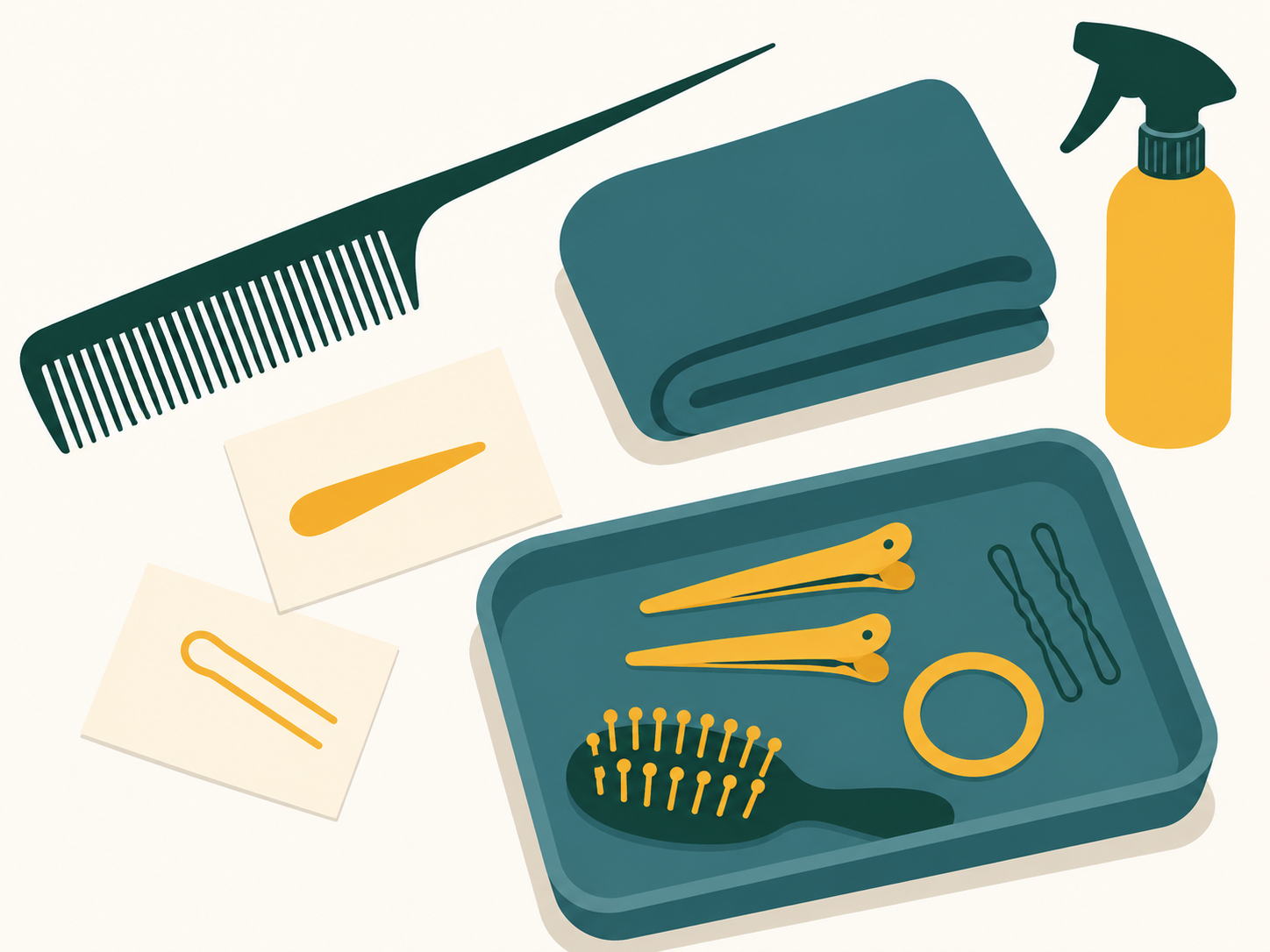
Alligator and duckbill are overlapping trade names, not reliable construction standards. For a wholesale assortment, identify the jaw shape, contact surface and opening rather than approving a line item from its name alone.
Alligator versus duckbill: specify the jaws
An alligator clip typically has opposing jaws with teeth or serrations that help grip a section. A duckbill clip usually has a longer, flatter jaw profile suited to holding separated hair during cutting, drying or styling (Sally Beauty, n.d.; Wojczak, 2021). Yet suppliers may use either name for similar elongated clips, and designs within each group vary.
The physical sample settles the specification. Check whether both jaws carry teeth, one jaw is smooth, or the contact faces are fully smooth. Then confirm the usable opening, because overall length alone does not show how much hair the clip can accept.
Tip: Send open, closed and underside reference views. A side view shows the jaw profile, while the underside reveals teeth, springs and any attached decoration.
Double-prong clips and adjacent pins
Double-prong curl clips are narrow setting tools used to secure a formed curl or wave. They should not be grouped with longer sectioning clips simply because both appear on a salon workbench. Bobby pins and U-shaped hairpins sit nearby in assortments, but they slide into the hair rather than close as a jawed clip.
Use the following buyer checklist when comparing samples:
- State the jaw profile: elongated, curved or compact.
- Specify teeth, serrations or smooth contact faces.
- Record the usable opening, not only overall length.
- Name the job: sectioning, curl setting or pinning.
- Show any pad, bow, logo plate or other attached decoration.
A construction-first brief prevents a familiar trade name from hiding a different mechanism.
Material, finish and mechanism are separate specifications
Material names describe resin families, while injection molding describes a production process. ABS (acrylonitrile butadiene styrene) and PP (polypropylene) are both compatible with injection molding (Formerra, n.d.-a) (Formerra, n.d.-c). Cellulose acetate is a material too, and some grades can be injection molded or processed by other routes in commercial production (Eastman Chemical Company, 2014) (Formerra, n.d.-b).

ABS, PC, PP and cellulose acetate
A resin datasheet helps narrow the choice, but it does not predict the performance of a finished clip by itself. Tooth geometry, wall thickness, hinge design, spring force, molding conditions and assembly all affect how the product behaves.
| Resin | Useful material characteristic | Specification consequence |
|---|---|---|
| ABS | Engineering thermoplastic used in injection molding, with rigidity, toughness and good surface-finish potential (Formerra, n.d.-a) | State the grade, color, finish and clip design. Do not treat "ABS" as a complete performance requirement. |
| PC | One of our available project resins | Confirm the grade during development and judge the assembled sample. No unsupported PC property claim should replace project-specific evaluation. |
| PP | Injection-moldable thermoplastic available in grades with differing stiffness and impact behavior (Formerra, n.d.-c) | Account for the selected grade and geometry. Our 105 mm CL-001 uses PP. |
| Cellulose acetate | Cellulosic thermoplastic available with processing routes that include injection molding for suitable grades (Eastman Chemical Company, 2014) (Formerra, n.d.-b) | Name the exact grade and process. "Acetate" does not automatically mean sheet-cut construction. We do not list acetate among our project materials. |
At our factory, injection-molded clip projects use ABS or PC, while CL-001 uses PP. Material selection is separate from the closure mechanism: changing resin does not turn a claw clip into a barrette or snap clip.
Color and surface finish belong in the brief
Specify solid or translucent color separately from matte or polished finish. Availability depends on the chosen material and design. We match color to an agreed physical sample or color standard, not a screen value, because displays and lighting can shift the buyer’s visual reference.
A useful brief names the model or drawing, resin, physical color reference, surface finish and acceptance sample. That combination is far clearer than asking for a "premium plastic" clip.
Where we can help
If your chosen clip family is a claw, bring your design and color direction into the manufacturing discussion. We make custom claw clips in our own injection-molding factory, with options for colors, logo and packaging, and samples before bulk orders. Explore custom options
Our existing-mold claw clip styles: 105–110 mm
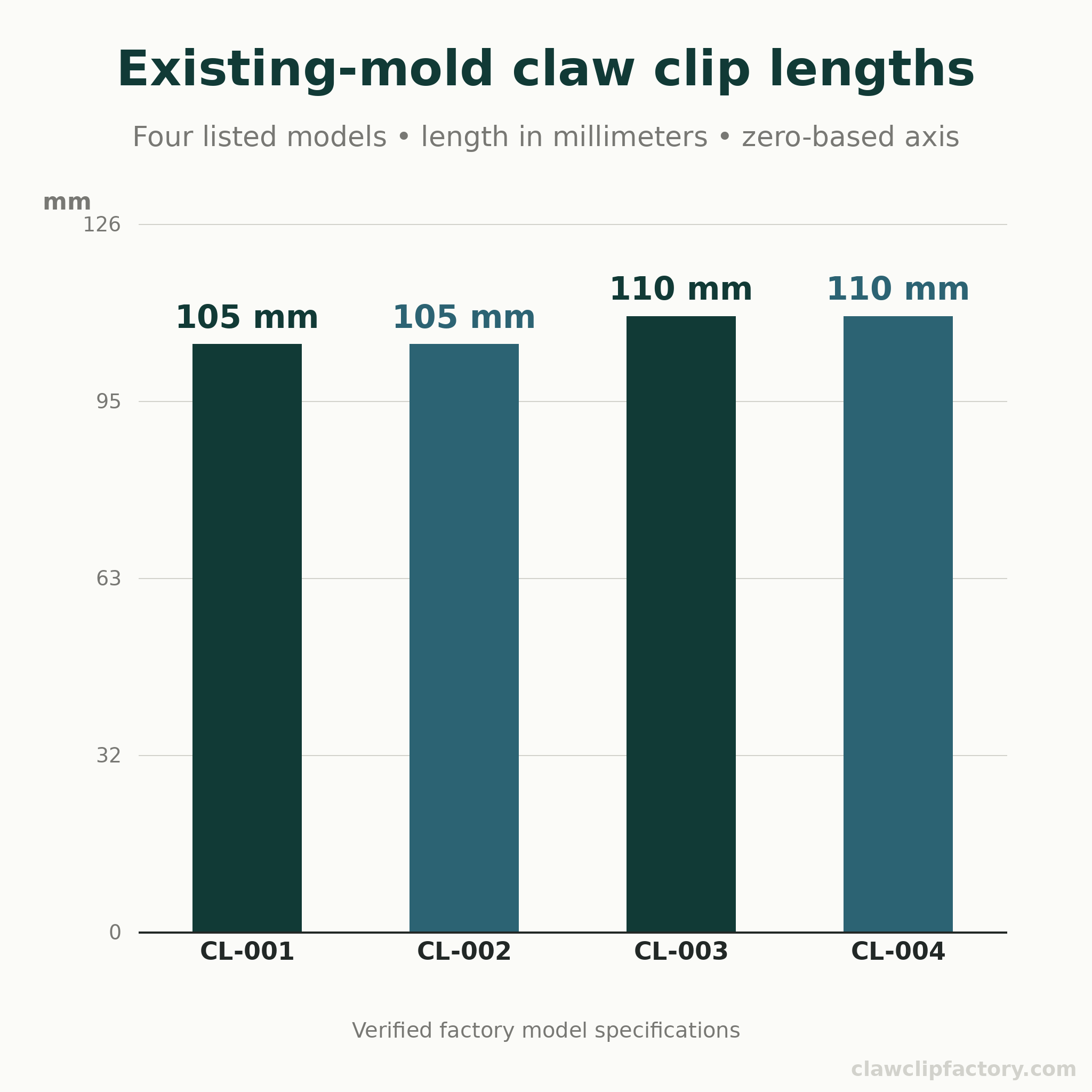
Our four listed claw clip models span 105 to 110 mm. They are variations within the same hinged claw family, with different cutout shapes, resins and surface finishes. All four come from existing molds and are supplied fully assembled.
The listed models and their resins
Use the model code when requesting samples or preparing an assortment:
- CL-001 Soft Flexible Moon Cutout: 105 mm, PP.
- CL-002 Rectangular Cutout Matte: 105 mm, ABS.
- CL-003 Skeleton: 110 mm, ABS, glossy.
- CL-004 Twist Cutout: 110 mm, ABS.
The resin belongs in the specification, not just the product name. CL-001 is the PP option in the listed group, while the other three models use ABS. Finish also needs its own line: CL-002 is matte and CL-003 is glossy. For color, logo, packaging or a new design route, see our custom claw clip manufacturing options.
Choose an assortment by style, not length alone
A 5 mm length difference does not establish jaw opening, hair capacity or grip ranking. Those depend on the complete geometry and mechanical structure. Select models by the visual direction and specification needed for the range, then review physical samples for the intended use.
A buyer might pair the softer moon-cutout look of CL-001 with the rectangular CL-002, or combine the open skeleton profile of CL-003 with the twist form of CL-004. The pairing decision is about assortment architecture, not a claim that one model performs better because it is longer.
Our standard starting MOQ is 1,000 pieces per style. Mixed-style orders are evaluated style by style, so four selected models do not become one combined MOQ. We have more than 10 existing mold styles in total, and current mold availability is confirmed for each inquiry.
How we turn a claw clip reference into an approved sample
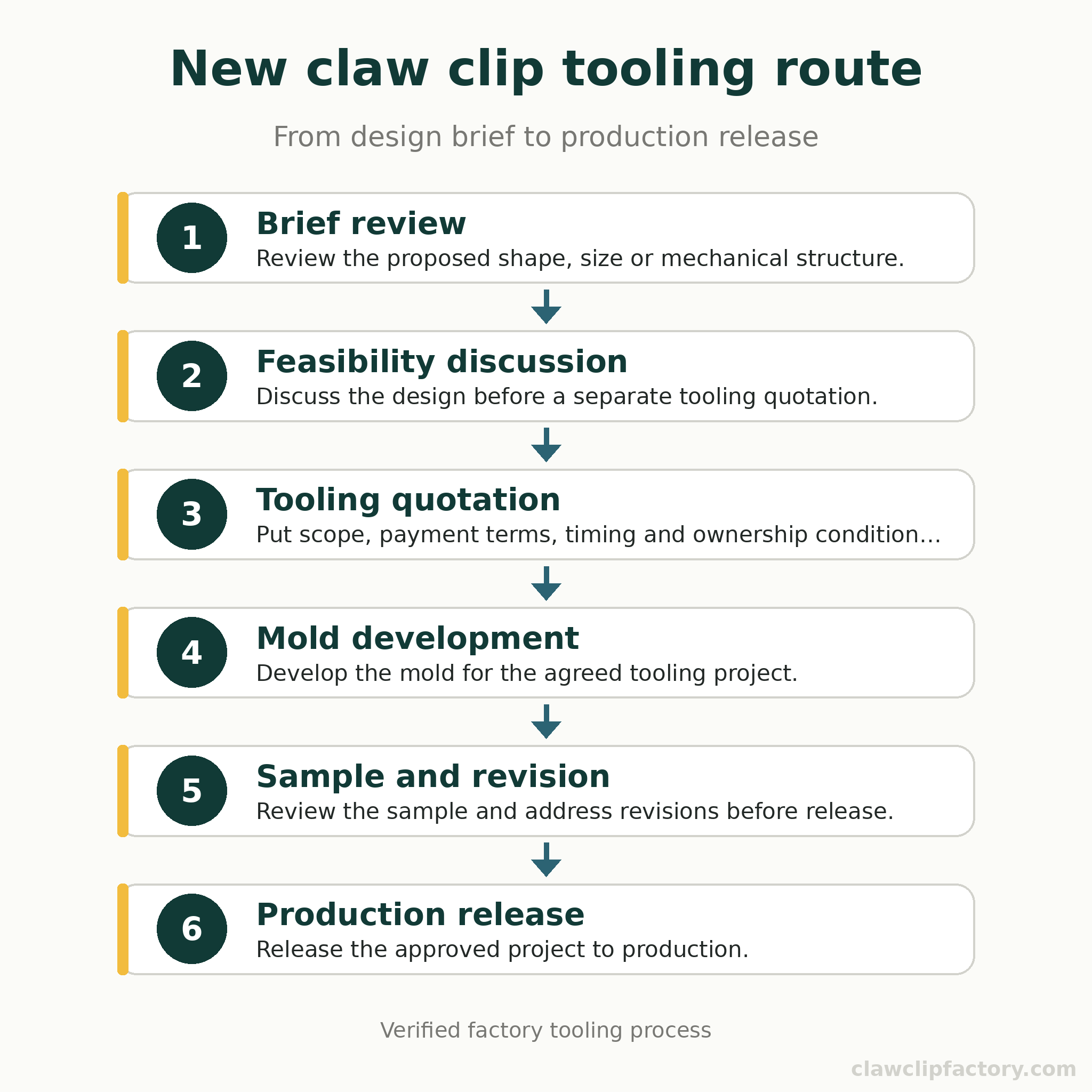
We are ClawClipFactory, the brand of Quzhou Jiahe Plastic Products Co., Ltd., an injection-molding manufacturer in Quzhou, Zhejiang, China. A useful reference shows the outside profile and the underside mechanism. We compare it with our available molds, then confirm whether the project is a color-and-finish change or a new structure. That decision separates an existing-mold sample from a tooling project with its own written scope.
Existing mold or separate tooling quotation
If an existing mold fits, we can discuss solid or translucent resin colors and matte or polished surfaces, subject to the material and design. Color is matched against an agreed physical sample or color standard, not a screen value. See our custom claw clip options for the available route.
A new shape, size or mechanical structure requires feasibility review and a separate tooling quotation. Before mold development, the written quotation sets out scope, payment terms, timing and ownership conditions. That prevents a visual reference from being mistaken for a complete mechanical specification.
Sample approval and repeat-batch controls
Our typical sample target is about 7 days after requirements, sample fee and freight are confirmed. Mold readiness, resin, color and sample scope can change the timing. The buyer pays the sample fee and freight, and an agreed sample-fee credit can be applied to the production order.
We handle injection molding, spring installation, assembly, inspection and packaging in-house. During inspection, we check visible defects, color consistency, filling, flash and deformation. After approval, we lock the molding conditions and retain them for repeat batches.
Send these details for a compact RFQ:
- Reference photos, including the underside
- Target dimensions and intended use
- Quantity required for each style
- Resin choice and physical color standard
- Finish and packaging format
Quote requests are answered within 24 hours. Our quotation page provides the fields for the brief.
Wholesale buyer FAQ
The most useful buying distinction is the closure mechanism. Names can overlap, but resin, finish, size and cutout shape should be specified separately from the way a clip opens and closes.
Are claw clips and jaw clips the same type?
Yes. "Claw clip" and "jaw clip" usually name the same hinged family: two toothed halves pivot around a spring and close like opposing jaws (Defenbaugh & Recchion, 2009). Butterfly, rectangle and twist describe body shapes within that family, not different closure mechanisms.
What is the difference between a snap clip and an alligator clip?
A snap clip uses a curved strip that bends through a snap action to switch between open and closed positions (Renstrom & Sherwin, 1963). An alligator clip uses a hinge and spring-loaded jaws; pressing the lever opens the gripping end (Wojczak, 2021). They need different product drawings, components and production methods.
Which materials can we choose for injection-molded claw clips?
We use ABS and PC for injection-molded clips, with the final resin selected for the project. Our CL-001 model is made in PP. Resin availability is model-specific, so a buyer should not assume that every existing mold can run every listed material.
Can we combine different claw clip styles in one wholesale order?
Our standard starting MOQ is 1,000 pieces per style. A multi-style order is evaluated style by style, so 1,000 pieces cannot normally be divided across several designs. Send the quantity, color, finish and packaging request for each style so we can quote the assortment accurately.
Does a new claw clip shape need a new mold?
A new shape, size or mechanical structure needs our feasibility review and a separate tooling quotation. We define the tooling scope, payment terms, timing and ownership conditions in writing before mold development. If an existing mold fits the requested structure, color, finish, logo and packaging can be reviewed as separate customization items.
Conclusion: choose the mechanism, then specify the style
Choose the closure family first, then define geometry, resin and finish. That order keeps the types of hair clips clear and prevents a style change from being mistaken for a different mechanism.
For a claw-clip project, compare the required body outline, length, cutouts and tooth layout with our available molds. If an existing mold matches the intended geometry, the sourcing brief can focus on the model, resin color, matte or polished surface, logo method and packaging format. The final resin is selected per project. Our injection-molded range uses ABS or PC, while CL-001 uses PP.
If the reference changes the shape, size or mechanical structure, treat it as new tooling rather than a color or finish request. We review feasibility first, then quote tooling scope, payment terms, timing and ownership conditions in writing before mold development and sampling.
The practical rule is simple: mechanism defines the family, geometry determines mold fit, and material plus finish define the production version. Keeping those decisions separate produces a clearer RFQ and the correct manufacturing route.
A smaller ask
Start with the claw clip design you want for your range, then share your color, logo and packaging ideas with us. Our custom manufacturing service includes samples before bulk orders so you can review your design before moving to bulk production. Get a quote
References
- Defenbaugh, M., & Recchion, J. (2009). Hair clip with concealed hinge spring (U.S. Patent Application Publication No. US20090272397A1). Google Patents. https://patents.google.com/patent/US20090272397A1/en
- Pignon, G. (2001). Monture de barrette à cheveux [Hair bar mount] (French Patent Application Publication No. FR2800248A1). Google Patents. https://patents.google.com/patent/FR2800248A1/en
- Sam Villa. (n.d.). Dry sectioning clips. https://www.samvilla.com/products/dry-sectioning-clips
- Formerra. (n.d.-a). Acrylonitrile butadiene styrene (ABS). https://www.formerra.com/products/chemistries/acrylonitrile-butadiene-styrene-abs
- Formerra. (n.d.-c). Polypropylene (PP). https://www.formerra.com/products/chemistries/polypropylene-pp
- Formerra. (n.d.-b). Cellulose acetate (CA). https://www.formerra.com/products/chemistries/cellulose-acetate
- Eastman Chemical Company. (2014). Tenite cellulosic plastics: From trees to plastic (PPC-100H). https://www.eastman.com/content/dam/eastman/corporate/en/literature/p/ppc100.pdf
- Renstrom, C. W., & Sherwin, R. C. (1963). Hair clip (U.S. Patent No. 3,082,773). Google Patents. https://patents.google.com/patent/US3082773A/en
- Wojczak, S. (2021). Hair clip (Canadian Patent Application Publication No. CA3160815A1). Google Patents. https://patents.google.com/patent/CA3160815A1/en
- Sally Beauty. (n.d.). Salon Care metal duckbill clips. https://www.sallybeauty.com/salon-supplies/salon-essentials/bobby-pins-and-clips/metal-duckbill-clips/SLNCAR17.html
Last reviewed and updated: November 2026. Author: ClawClipFactory Team. Need custom claw clips? Send us your design or reference photos for a quote. Contact our team.