TL;DR
Common types of claw clips include classic curved, rectangular, oval, cutout, flat, octopus, mini and novelty styles. These descriptions can overlap: our CL-002 is both rectangular and cutout, measures 105 mm and comes from an existing mold. Choose the silhouette first, then specify size, material and finish separately.
8 types of claw clips and how to recognize them
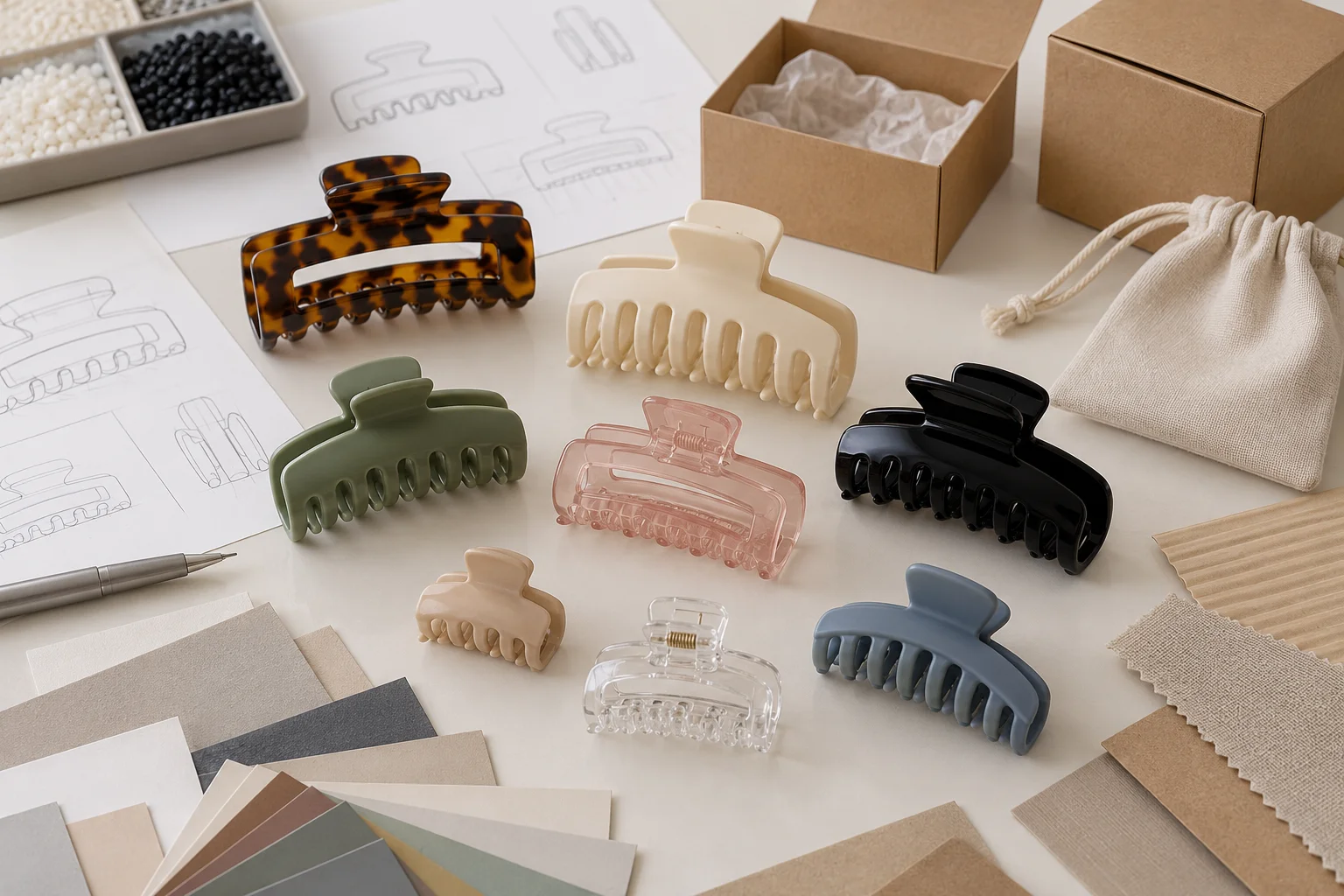
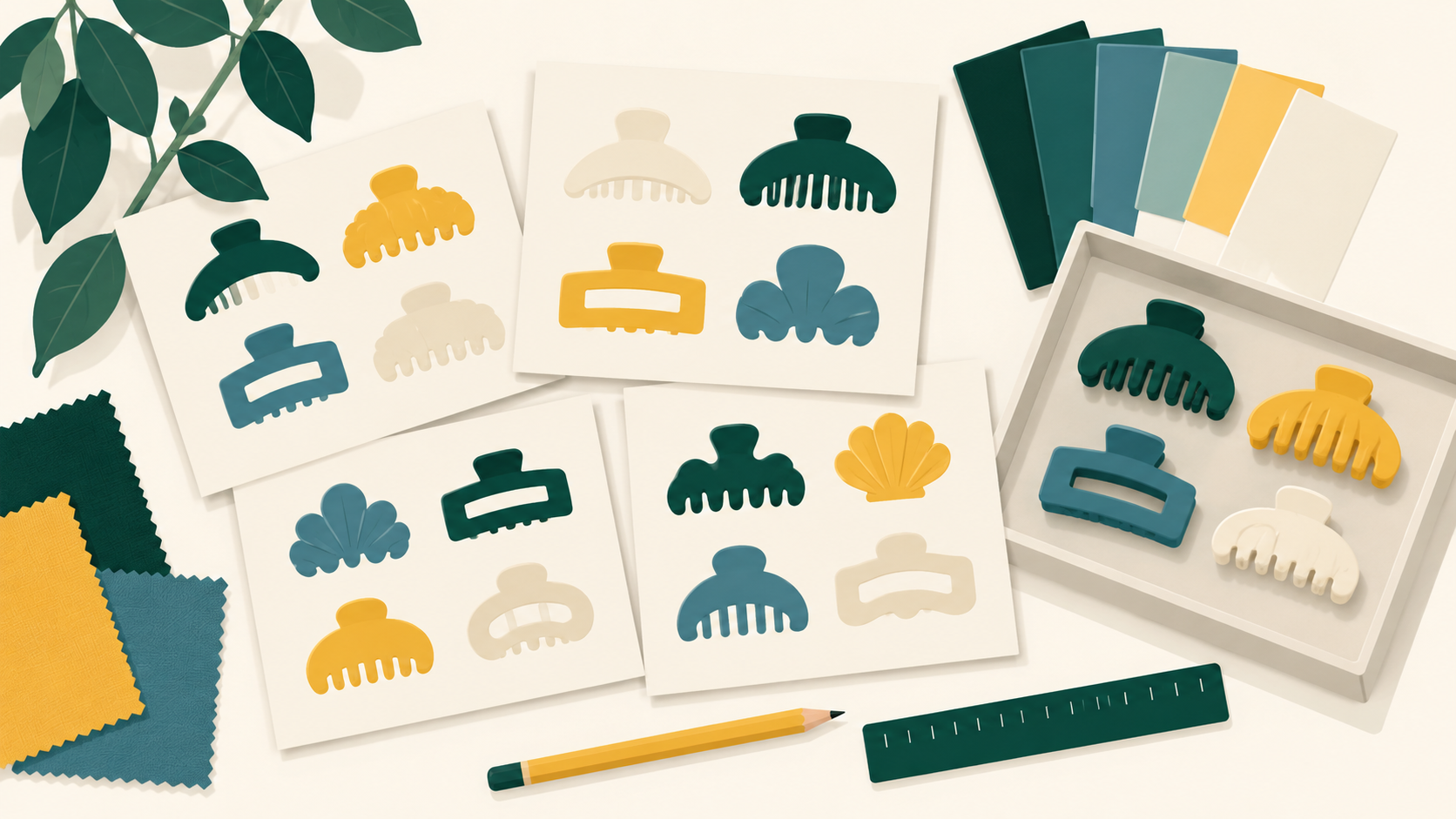
The eight common descriptions are classic curved, rectangular or square, oval, cutout or skeleton, flat, octopus, mini, and novelty claws.

Treat these as visual descriptions rather than standardized, mutually exclusive constructions. Mini refers to scale, flat refers to the side profile, and cutout refers to open areas in the body. Matte is a surface finish, while tortoiseshell is an appearance pattern. Neither creates another clip mechanism.
| Style description | Visible identifier | Detail to specify |
|---|---|---|
| Classic curved | Arched body with opposed jaws | Overall length and jaw depth |
| Rectangular or square | Straight-edged, angular outline | Corner shape and body proportions |
| Oval | Elongated, rounded outer line | Length-to-width proportion |
| Cutout or skeleton | Open sections through the body | Opening pattern and bridge thickness |
| Flat | Lower-profile body from the side | Closed side-profile height |
| Octopus | Rounded body with surrounding claw-like teeth | Tooth arrangement and body diameter |
| Mini | Compact version of another shape | Exact dimensions, not the word mini |
| Novelty or decorative | Flower, butterfly, or themed outline | Reference image and decorative features |
1. Classic curved claws
A classic claw has two curved body halves that meet as opposed jaws. Viewed from the side, the body usually forms a raised arch around the hinge area. Editorial roundups also use "classic" as a familiar retail description. (Segal, n.d.) For sourcing, add dimensions and a side-view image because the curve can vary widely.
2. Rectangular and square claws
These clips use an angular outer silhouette, often with straighter top edges and more defined corners than curved or oval designs.
3. Oval claws
Oval claws have a rounded, elongated outline when seen from the broad side. They differ visually from rectangular styles through continuous curves rather than straight edges and corners. A buyer should specify the overall proportions because a narrow ellipse and a broad rounded body may both be sold under the oval name.
4. Open, cutout and skeleton claws
Open and cutout clips have visible spaces through the body rather than a fully solid shell. Skeleton usually suggests a more exposed rib or frame pattern, but usage varies. Our CL-001 moon cutout, CL-003 skeleton, and CL-004 twist cutout illustrate how the opening pattern can combine with a separate silhouette name.
5. Flat, low-profile claws
Flat describes the side profile, not the front outline. The body sits lower when viewed from the hinge or tooth side than a strongly arched classic claw. A flat clip can still be oval, rectangular, cutout, or decorative. Specify the closed profile height and provide side and top views.
6. Octopus claws
An octopus claw is recognized by a rounded central body and multiple curved, claw-like teeth arranged around it. The retail name is visual rather than a technical construction standard. A reference should show the tooth layout, hinge position, overall diameter, and side profile so the intended geometry is clear.
7. Mini claws
Mini means compact scale, but it has no universal size cutoff. The underlying shape may be classic, rectangular, cutout, butterfly, or another design. Editorial examples confirm mini claws as a familiar category description. (Segal, n.d.) For a wholesale brief, replace relative words such as mini or small with exact dimensions.
8. Novelty and decorative claws
Novelty claws use a recognizable decorative outline or applied motif, such as a flower or butterfly. Patterned and decorative examples also appear in fashion editorial coverage. (Segal, n.d.) Separate the outline from the decoration when specifying one: a butterfly-shaped body differs from a conventional claw carrying a butterfly accent.
Match the silhouette to the opening and side profile
Overall length is only one part of a clip reference. Two clips with the same length can differ in jaw depth, opening, internal space and tooth arrangement. Compare those features as geometry, not as a promise that one design will suit every hair texture.
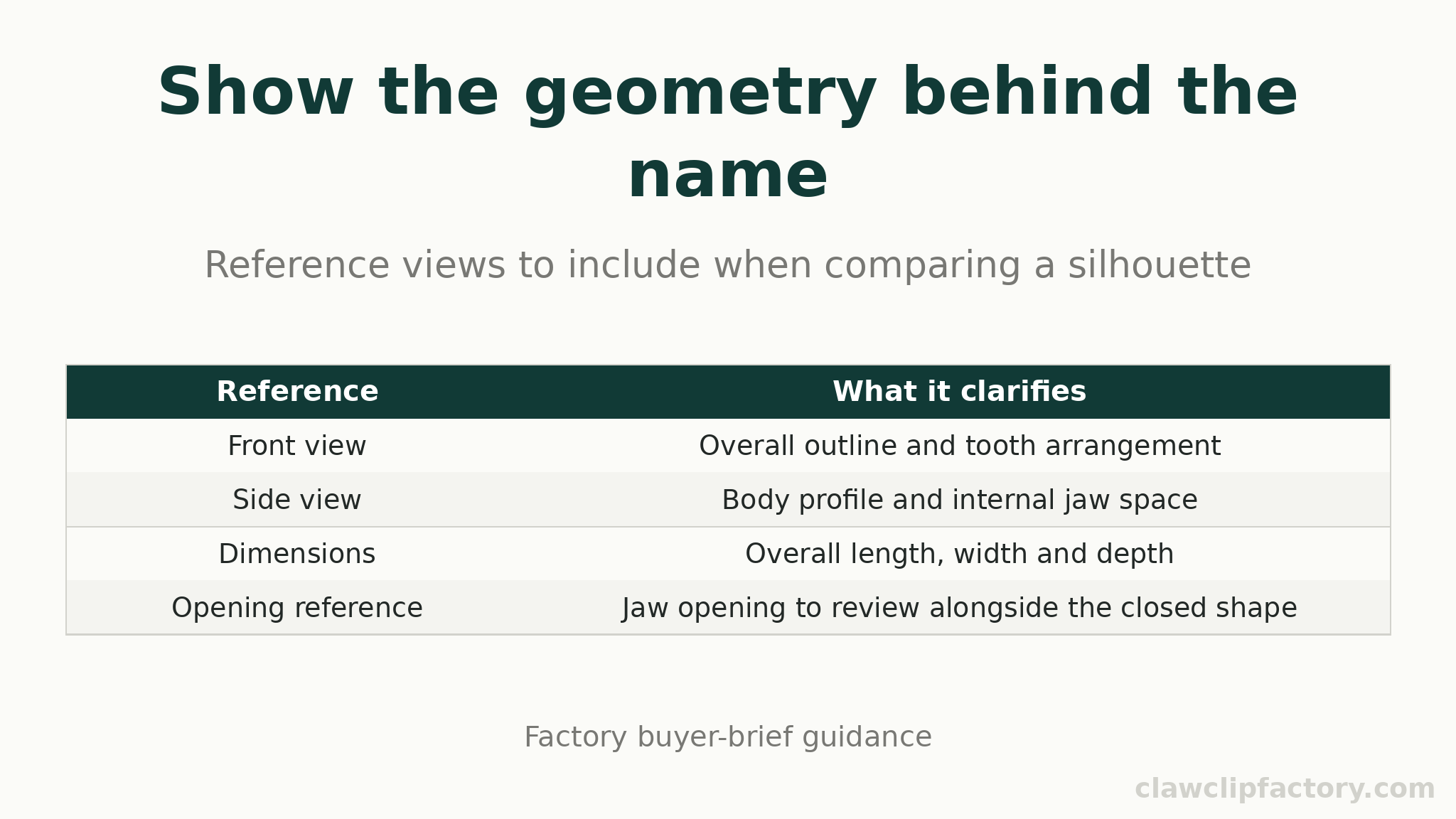
Compare geometry rather than a hair-type label
A useful reference brief should show what the style name leaves out. Include:
- Overall length, width and height
- Front silhouette and side profile
- Internal jaw space when closed
- Tooth count, spacing and arrangement
- Opening shown beside a ruler or agreed scale
For a flat or octopus reference, send clear front and side views. The front view identifies the outline. The side view shows whether the body sits low, rises into a deep curve or uses rounded arms. The name alone cannot communicate those differences.
Separate the spring mechanism from the style name
Terms such as rectangular, cutout or octopus describe appearance. They do not fully define the hinge area, spring arrangement or how the two halves meet. Treat mechanism details as a separate specification when comparing samples or requesting a new shape.
One published hair-clip design documents two opposed body members connected around a pivot, with a pin and torsion spring in the hinge assembly.(Defenbaugh & Recchion, 2009) It is one documented mechanism example, not a universal construction for all claw clips. Buyers should compare the actual hinge and opening shown in their reference.
See what we would find
Pair your chosen silhouette with the colors, logo and packaging you want for your range. We make custom claw clips in our own injection-molding factory, with samples before bulk orders. Get a Quote
Our existing-mold examples: 105 mm and 110 mm styles
We are ClawClipFactory, the brand of Quzhou Jiahe Plastic Products Co., Ltd., a plastic injection-molding manufacturer in Quzhou, Zhejiang, China. Our current examples give buyers four assembled starting points across 105 mm and 110 mm lengths. The model name describes the silhouette, while resin and finish remain separate specifications. A 110 mm body should not be read as proof of stronger hold.
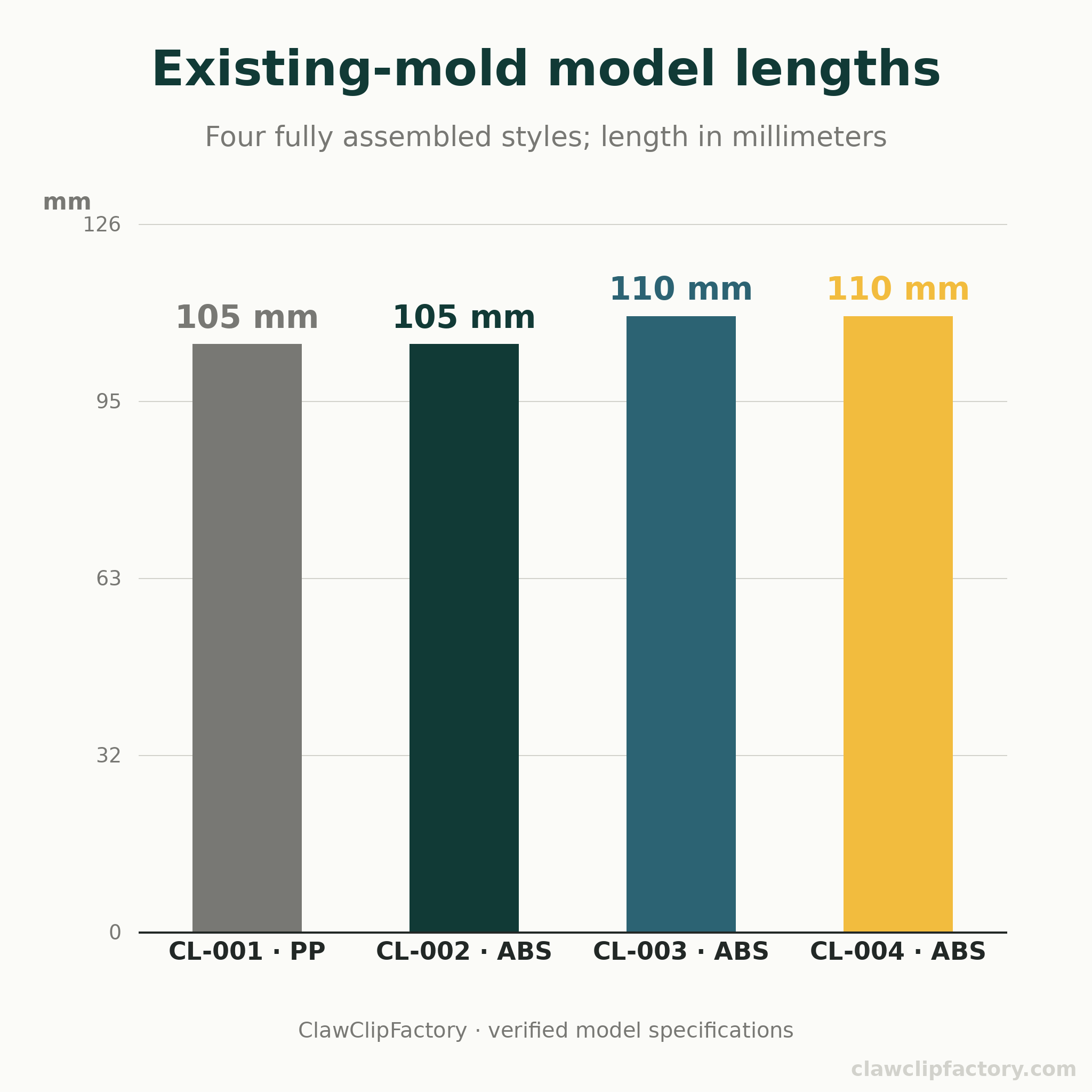
Four assembled models to compare
These four models come from existing molds and are supplied fully assembled:
- CL-001 Soft Flexible Moon Cutout, 105 mm, PP
- CL-002 Rectangular Cutout Matte, 105 mm, ABS
- CL-003 Skeleton, 110 mm, ABS, glossy
- CL-004 Twist Cutout, 110 mm, ABS
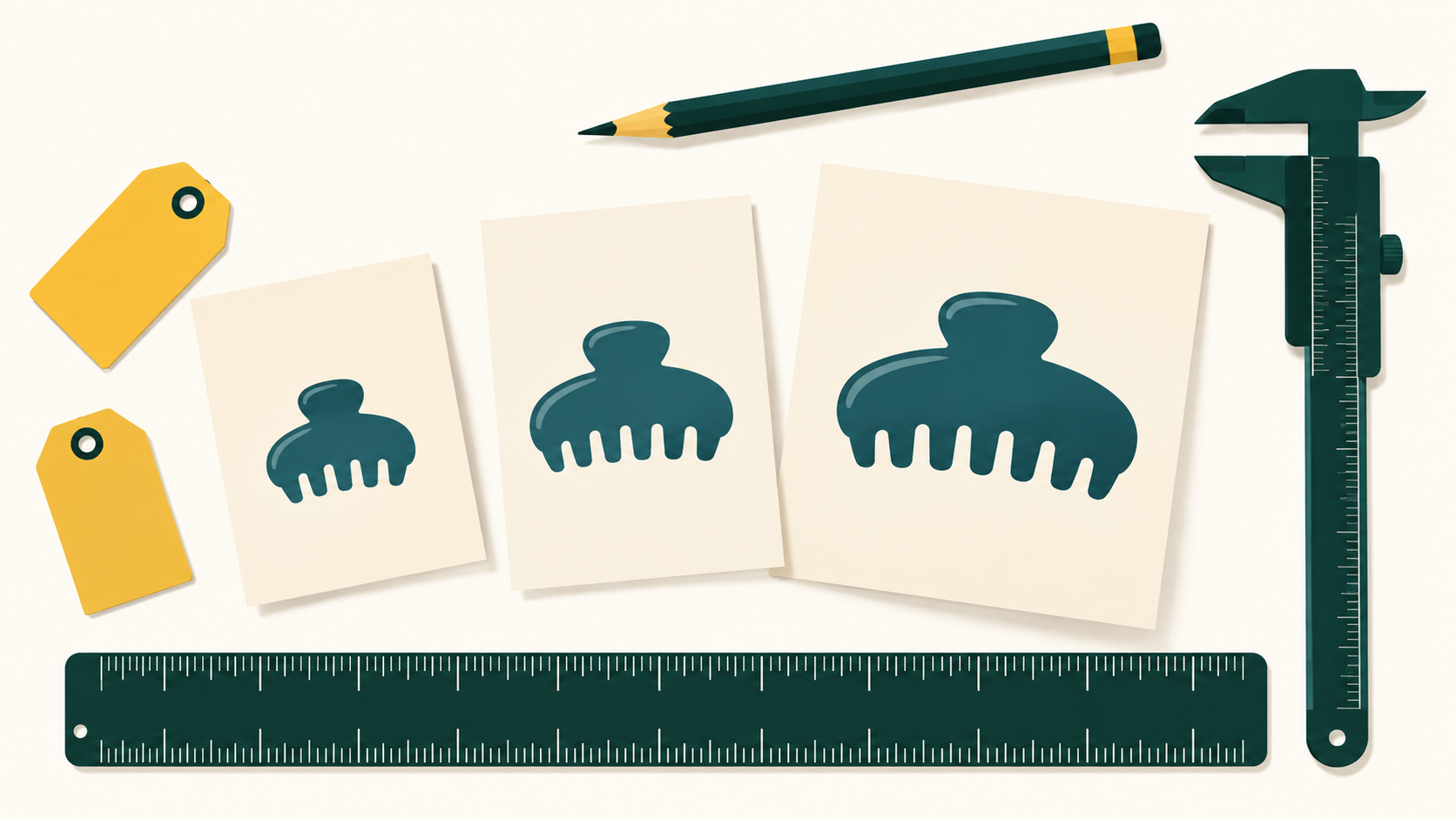
The length chart compares body length only. For a broader starting point, buyers can review our existing-mold claw clip range.
Build a mixed-style assortment by style
A mixed order is evaluated style by style, so quantities are not automatically pooled across different models. For example, combining CL-002 and CL-003 creates two style lines for MOQ review rather than one shared quantity.
That distinction matters when planning an assortment. Choose the shapes that serve separate positions in the range, then set the quantity, resin color, finish and packaging for each style. This keeps a mixed selection commercially clear without treating a shared length as a shared specification.
Choose material and finish separately from shape
Shape defines geometry. Resin, color and finish are separate choices. ABS means acrylonitrile butadiene styrene; PC means polycarbonate; PP means polypropylene. (INEOS Styrolution, 2016; Covestro, n.d.; LyondellBasell, n.d.) A rectangular clip may be matte or polished, solid or translucent, without becoming a different shape. Specify each choice independently in the purchasing brief.

ABS, PC, PP and cellulose acetate
Material names begin a technical discussion rather than settle it. Properties vary by formulation and grade, so data-sheet values should not be copied into a finished clip specification.
| Resin family | Relevant material distinction | Sourcing implication |
|---|---|---|
| ABS | An example molding grade offers colorability and a high-quality surface finish or gloss. (INEOS Styrolution, 2016) | Consider it when color and surface appearance drive the brief. Select the grade by project. |
| PC | The family includes transparent, impact-resistant materials and injection-molding grades. (Covestro, n.d.) | Consider it when clarity or translucency must be balanced with mechanical needs. |
| PP | Homopolymers and copolymers offer different stiffness and impact profiles. Injection-molding grades are available, and PP has low density relative to most polymers. (LyondellBasell, n.d.) | Specify the required behavior instead of assuming every PP grade is soft. |
| Cellulose acetate | This cellulosic thermoplastic is available in injection-molding compositions supplied as pellets. Formulation affects properties. (Eastman Chemical Company, 2020) | Treat acetate as an industry material, not as one of our stated material options. |
At our factory, we use ABS and PC for injection-molded projects, and select the final resin for each project. CL-001 is made in PP. Its material does not mean PP can replace ABS in another mold without reviewing the design and molding requirements.
Solid color, translucency, matte and polish
Tortoiseshell describes an appearance, not a resin identity. Specify the base resin separately from the color effect and surface.
We offer custom solid or translucent resin colors, plus matte or polished surfaces where the material and design permit. We match color to an agreed physical sample or color standard, not a screen value. See our color and finish customization options when preparing the visual brief.
For sample approval, record four independent fields: shape, resin, color reference and surface finish. This keeps a word such as "matte" from being mistaken for a material or one of the types of claw clips.
How we turn a style reference into samples and production
A style reference becomes useful when it is paired with dimensions, material choices and order details. We use that handoff to decide whether an existing mold fits or a new tool needs review.
Existing molds and the sample target
When a selected model or reference is close to one of our existing molds, we compare the requested size, resin, color and finish with that mold’s current setup. The reference can be a product sample, drawing or clear set of views.
Send these details with the inquiry:
- Selected model number or reference views
- Required overall dimensions
- Quantity for each style
- Resin, color and finish preference
- Packaging format or packing requirement
Our typical sample target is about 7 days after the requirements, sample fee and freight are confirmed. Actual timing depends on mold readiness, material, color and sample scope. The buyer pays the sample fee and freight. When agreed during quotation, the sample fee can be credited against the production order.
New geometry and the tooling route
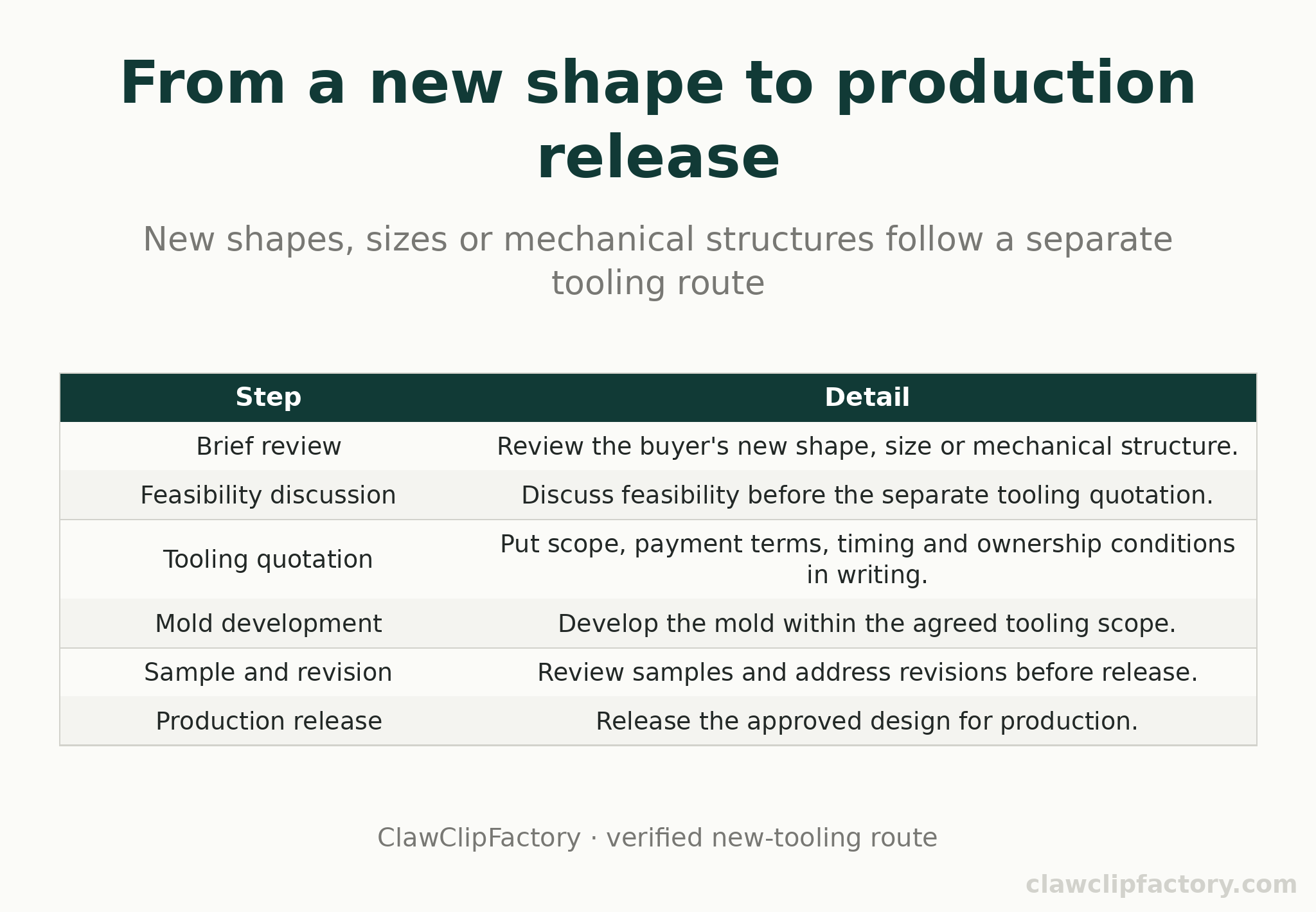
Our tooling process follows an ordered path through review, mold development, sampling and revision, and production release. Buyers can also review our new-mold tooling route when preparing an original design.
What we check in-house
Injection molding, spring installation, assembly, inspection and packaging are handled at our factory. We check molded parts for visible defects, color consistency, complete filling, flash and deformation. After the buyer approves the sample, we lock the molding conditions and retain them for repeat batches.
That separation matters: the approved sample defines the product target, while retained molding settings give the production team a controlled starting point for the next batch.
Wholesale style-selection FAQ
Our existing molds can shorten the route, while size, structure and resin changes may require separate review.
Which claw clip shapes can we order from existing molds?
We have more than 10 existing mold styles, with current availability confirmed for each inquiry. Representative options include the CL-001 moon cutout, CL-002 rectangular cutout, CL-003 skeleton and CL-004 twist cutout. These models are supplied fully assembled.
Can we mix rectangular and cutout clips in one wholesale order?
Our standard starting MOQ is 1,000 pieces per style, and we evaluate multi-style orders style by style. List each requested model, color, finish and quantity separately.
Does changing the clip size require new tooling?
A new size, shape or mechanical structure needs a feasibility review and separate tooling quotation. The written quotation covers scope, payment terms, timing and ownership conditions before mold development begins. A cosmetic color change is specified separately and does not redefine the clip dimensions.
How should we specify a flat or octopus shape without relying on the name alone?
Send reference views from the front, side and open positions, then add overall dimensions and the intended tooth layout. The side profile is especially useful because two products sold under the same shape name can have different curvature, opening geometry or jaw depth. We review the geometry rather than assuming that "flat" or "octopus" describes one fixed construction.
Can we select PP instead of ABS for the same design?
CL-001 uses PP, while our other listed existing-mold models use ABS; PC is also available for injection-molded projects. We select the final resin by project. Changing resin requires a design and molding-process review because PP is not treated as an automatic drop-in substitute for ABS or PC.
Choose a recognizable style, then define the specification
A familiar style name starts the discussion, but a model reference, dimensions and finish turn that discussion into a product we can quote. Use types of claw clips as identification language, not as a complete specification.
For an existing mold, send the model number if known. If you are matching another product, send clear reference photos showing the front, side profile, teeth and hinge area. Include overall length, width, desired material or flexibility, solid or translucent color, matte or polished surface, packaging needs and quantity per style.
Quantity per style also matters because mixed assortments are evaluated style by style.
We answer quote requests within 24 hours. That response can confirm the relevant existing-mold route or identify where a new shape, size or mechanical structure needs a separate tooling discussion.
Conclusion
The most useful way to compare claw clip styles is to separate silhouette, profile, size, resin and finish. Start with a recognizable shape, then send us the model or reference views and quantity per style so we can quote an existing-mold option or review new tooling.
A smaller ask
Start with the design you want to develop, rather than a style name alone. Send us your design and your color, logo and packaging preferences to discuss custom claw clips and samples before a bulk order. Discuss your design
References
- Segal, L. (n.d.). The 14 essential claw clips and how to wear them. Harper’s BAZAAR. https://www.harpersbazaar.com/beauty/hair/g38979021/best-claw-clips/
- Defenbaugh, M., & Recchion, J. (2009). Hair clip with concealed hinge spring (U.S. Patent Application Publication No. US20090272397A1). U.S. Patent and Trademark Office. https://patents.google.com/patent/US20090272397A1/en
- INEOS Styrolution. (2016, January 17). Terluran GP-22: Acrylonitrile butadiene styrene (ABS) [Technical data sheet]. https://plastore.it/cgi2018/file818/1_abs%20terluran%20gp22.pdf
- Covestro. (n.d.). Makrolon: Polycarbonates. https://solutions.covestro.com/brands/makrolon
- LyondellBasell. (n.d.). Pro-fax. https://www.lyondellbasell.com/en/our-solutions/products/polymers/trade-name/pro-fax
- Eastman Chemical Company. (2020, April). Tenite cellulosic plastics: Injection molding (SP-TRS-10303). https://www.eastman.com/content/dam/eastman/corporate/en/literature/s/sptrs10303.pdf
Last reviewed and updated: October 2026. Author: ClawClipFactory Team. Need custom claw clips? Send us your design or reference photos for a quote. Contact our team.